And it’s already the second half of October! Casual greetings on the street are dominated by comments about how chilly it is, and we all have raincoats, boots, and umbrellas on hooks or in closets near the door. The other day I had to come back in and dig out my gloves, and I’m unlikely to go out without them now until April — my circulation somehow begrudges my fingers. . . .
So as important as it is to have those warmer outdoor layers handy for whatever excursions we have planned, it’s also imperative that we have a stack of books and a good supply of tea or cocoa for those days when the weather insists on an Indoor Day. I have a few recommendations for you from my September reading, and I hope that, as usual, you might suggest a few more in the comments below.
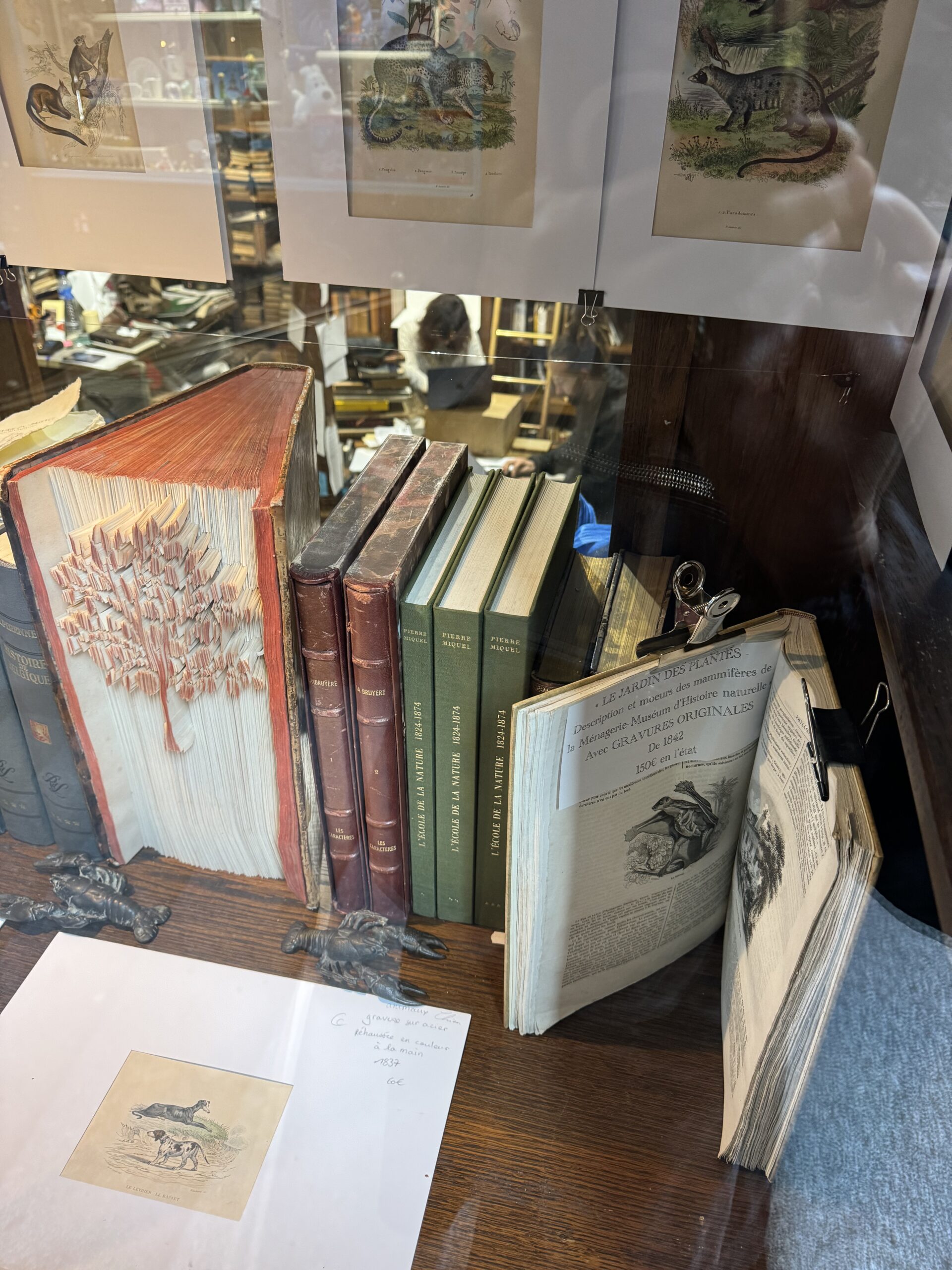
As usual, the numbering in this post comes from my annual handwritten reading journal, and the italicized text below is directly transcribed from that journal’s pages (once upon a time, I simply included photographs of those pages, but too many of you found my handwriting tough to decipher, especially in the photographed format). Notes to myself, that is, so that I can remember a book and remember my response to it, rather than any attempt at a more polished, edited review.
I’ve used regular font for any additions to my journal notes and included references to any posts from my Instagram Reading account.
55. The Dark. Valentina Giambanco. Mystery; police procedural; Alice Madison series; Pacific Northwest/Seattle; female detective.
This is the second in the Alice Madison series and follows up on some elements that formed background to The Gift of Darkness (#53 in this post). Alice and her colleagues are trying to solve a series of killings whose victims, she realizes, must be of potential witnesses to a decades-old crime: the kidnapping of three young boys, one of whom was killed. And once again, Alice must trust two men (one a prominent lawyer, the other assuredly a killer) connected to each other through that kidnapping.
Only one more to read in this series and it doesn’t appear that Giambanco has written anything since Book 4, the one we started with. Too bad! Highly recommend the three I’ve read so far.
56. We Measure the Earth with Our Bodies. Tsering Yangzom Lama. Literary fiction; Exiles/Refugees; Tibet, history; Canadian immigration.
By a Tibetan writer who now lives here in Vancouver, this book complicates and enriches our understanding of refugee/exile/immigrant identities. It begins shortly before a community is exiled from its Tibetan home by the Chinese invasion of 1960. Two young sisters, Lhamo and Tenkyi, lose their parents, suffer poverty, hunger, and many other hardships on their way to the refuge they eventually find in Nepal. The journey to, and the settling into, this provisional home is accompanied by the shockingly accelerated confrontation with modernity. Ancient traditions shaped by Buddhist beliefs have hitherto governed all aspects of daily life, but are difficult to maintain in new environments.
We switch narrative point-of-view halfway through the novel to follow the daughter of one of the sisters who made that trek to Nepal. Her mother — the older sister — stayed behind in the refugee camp in Nepal; Dolma lives with her Aunt Tenkyi in Toronto. Tenkyi works as a cleaner, and she struggles with her memories, with the alienation she feels in Toronto; Dolma aspires to a spot in a Tibetan Studies grad program.
Dolma considers herself Tibetan, yet she has never visited the country herself. But invited by her academic mentor to a soirée at the home of a wealthy art-collecting couple, potential sponsors, she recognizes an important ancient statue — The Nameless Saint — which once resided in her family’s humble home in the Nepal refugee camp. Now she must make choices, sort out loyalties and aspirations, alter trajectories.
A beautifully written master class in longing and belonging. ( In this interview with the author at the Victoria Festival of Authors, she explains the title: “Thematically the title has many meanings. The first is about our direct connection to land and how important land is for Tibetans. We have an ancient practice of doing full body prostrations around holy sites or across a great distance in pilgrimage. This is a way of showing reverence and worshipping the land which we consider to be home to gods and spirits.”)
57. Consider Yourself Kissed. Jessica Stanley. Domestic fiction; Romance; Set in London, England; British politics (Brexit!).
Recommended on Cup of Jo, so I shouldn’t be surprised that I’m probably not the target demographic. So much about that particular age and class and the problems parenting brings to a marriage that has so far relied on love and sexual passion, etc. to sort out gendered roles. I recognized much of this and some of it was very funny, some so familiar as to be poignant. Just hard for much of it to feel very urgent or particularly relevant to me at this age and stage of my life.
Some characters I really liked — female friendships were well limned, and, especially, those relationships that turned out to be truly supportive against expectations. The messy mixed marriages, etc.
The background of recent British politics was engaging, often droll.
I’d be more likely to recommend this as well-written light reading that nonetheless packs an entertaining (and observant) punch — but for my daughters and their friends rather than my friends. Still, it was fun to read and it’s probably good to pick in at the younger folks’ world occasionally, she says with a wink 😉
58. The Weekend. Charlotte Wood. Literary fiction; female friendship; women’s lives; senior women.
Honestly, this is a book to own and underline sections of and make a few notes, but I only had a copy borrowed from the library and too many books with looming due dates.
Three women about my age gather at Christmas at the beach house of a recently deceased friend. They’re going to clean out the cottage and prepare it for sale while spending one last Christmas together, as they’ve done for years. The women have been friends since the ’70s, and the grief they’re experiencing over their shared bereavement, the imminent loss of their time at the cottage together, is releasing their impatience with each other, as each of them processes the realities of aging — loss of companionship, of work, of security.
If it weren’t for the quality of Wood’s writing, I couldn’t have borne some of her observations about aging, about female friendships, about loneliness and marriage and need. She skewers some of our pettiest resentments, reveals some of the ugliest truths that can be hidden behind the exigencies of long-term relationships, the exasperation we buckle back until it escapes us exactly when it does the most damage. I’m glad I kept reading though because the ending is a clever testament to those friendships, just when they seem to have been sundered beyond repair.
Set at the beach, but definitely not just another beach book. Recommended with that proviso. Reads well with Mrs. Palfrey at the Claremont (Although much more positive perspective on age than that book!)
59. A House in the Mountains: The Women Who Liberated Italy from Fascism. Caroline Moorehead.
Such an inspiring book to read as fascism is again — horrifyingly — on the rise and seems to be increasingly sanctioned, somehow, in countries whose armies once fought against it. The potential for resistance, the strength and courage and intelligence of women to lead and to support this resistance — all so worthy of recollection at this historical moment, and Caroline Moorehead has done a great service in searching out and bringing together in a compelling narrative so much extant material that hadn’t previously been translated into English and/or compiled, collated, and contextualized.
Reading this, I gained an ever clearer sense of the political and geographical divisions in Italy that resulted in it aligning itself with the Third Reich even though a significant proportion of the population was opposed to fascism. Moorehead’s account also emphasizes the fear of communism that made the Allies so reluctant to trust any help from the Italian Resistance — and thus made the courageous struggle of the partigiani even more difficult . She touches on the complicated role of the Church, the mistrust of North and South for each other, class divisions, religious, etc.
Such a trenchant presentation of so much material evidence that has nonetheless been slow to gain well-deserved attention. And despite the very serious historic topic, the prose is propulsive. Highly recommended.
Reads well with Natalia Ginzburg’s Lessico Famigliare, Alba de Cespedes’ Her Side of the Story; and Iris Origo’s War in Val D’Orcio.
60. Misty of Chincoteague. Marguerite Henry. Illustrations by Wesley Dennis. Children’s literature; American history; wild ponies of Chincoteague.
I requested this book from our library inspired by blog-reader Darby, who lives close enough to Chincoteague to visit it annually and even to get there pre-dawn on the day of the pony swim from Assateague Island to Chincoteague Island, the last week each July — as described in this delightful and enduring children’s book. Each time Darby’s mentioned Chincoteague over the years of our social-media friendship here, I’ve recalled the many Ponies of Chincoteague books by Marguerite Henry that I read as a child. And last month I finally got ’round to rereading the one I loved best.
The book begins with the shipwreck of a Spanish galleon delivering “Moor ponies” to the Viceroy of Peru hundreds of years ago. Instead of arriving there to be sold to work in the mines, the ponies swam to a new life on Assateague Island
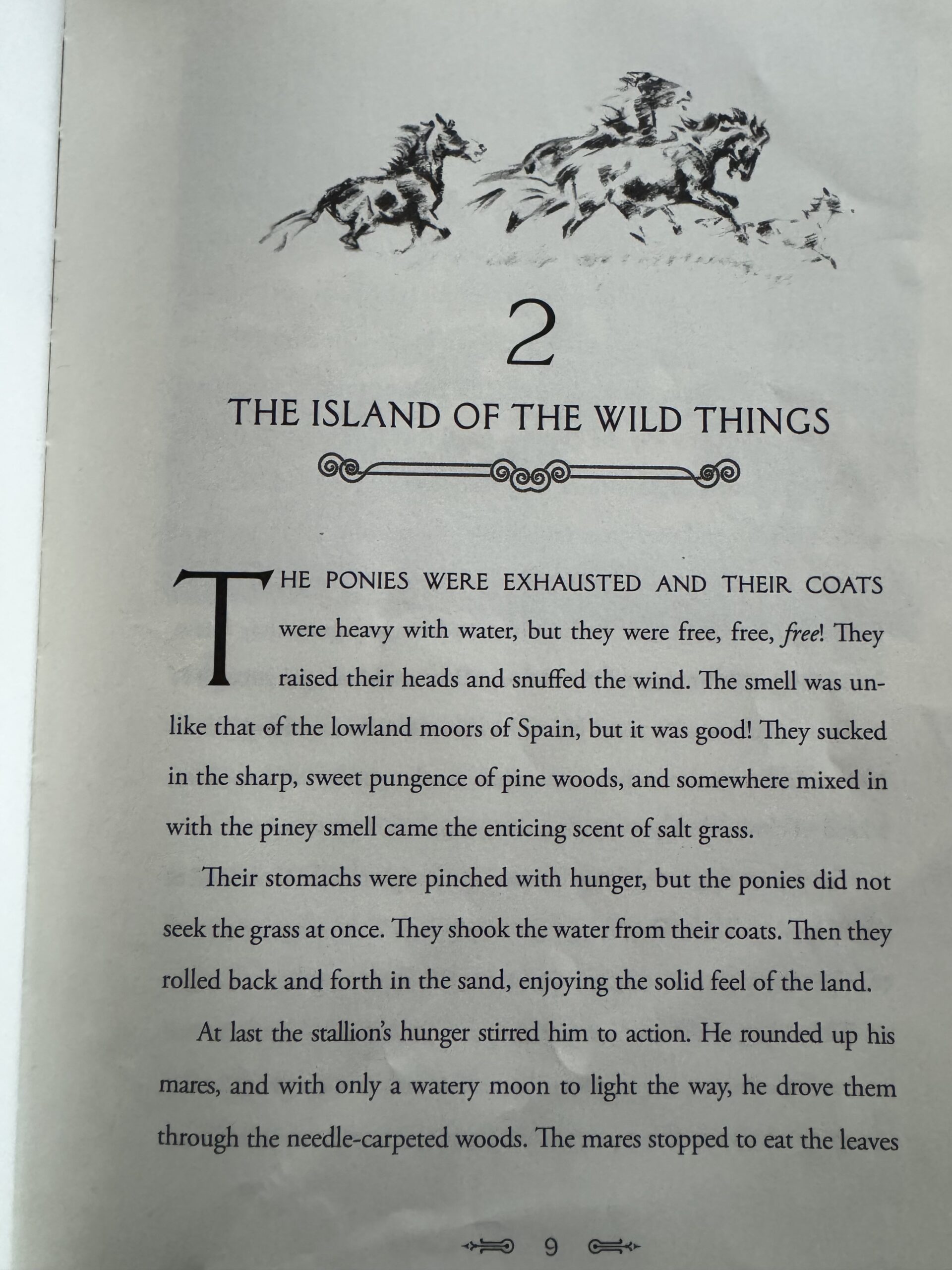
Centuries later, at the end of each July, the new colts and fillies were herded to swim over to Chincoteague Island where they were captured and then sold to raise funds for the fire department. Paul and Maureen, who live with their grandparents on Chincoteague, decide they want to buy Phantom, the wildest and fastest of the adult ponies, the pony who has escaped the round-up the past two years Against all expectations, though, Paul manages to capture her, slowed down as she is by a new foal whom the brother and sister name “Misty.”
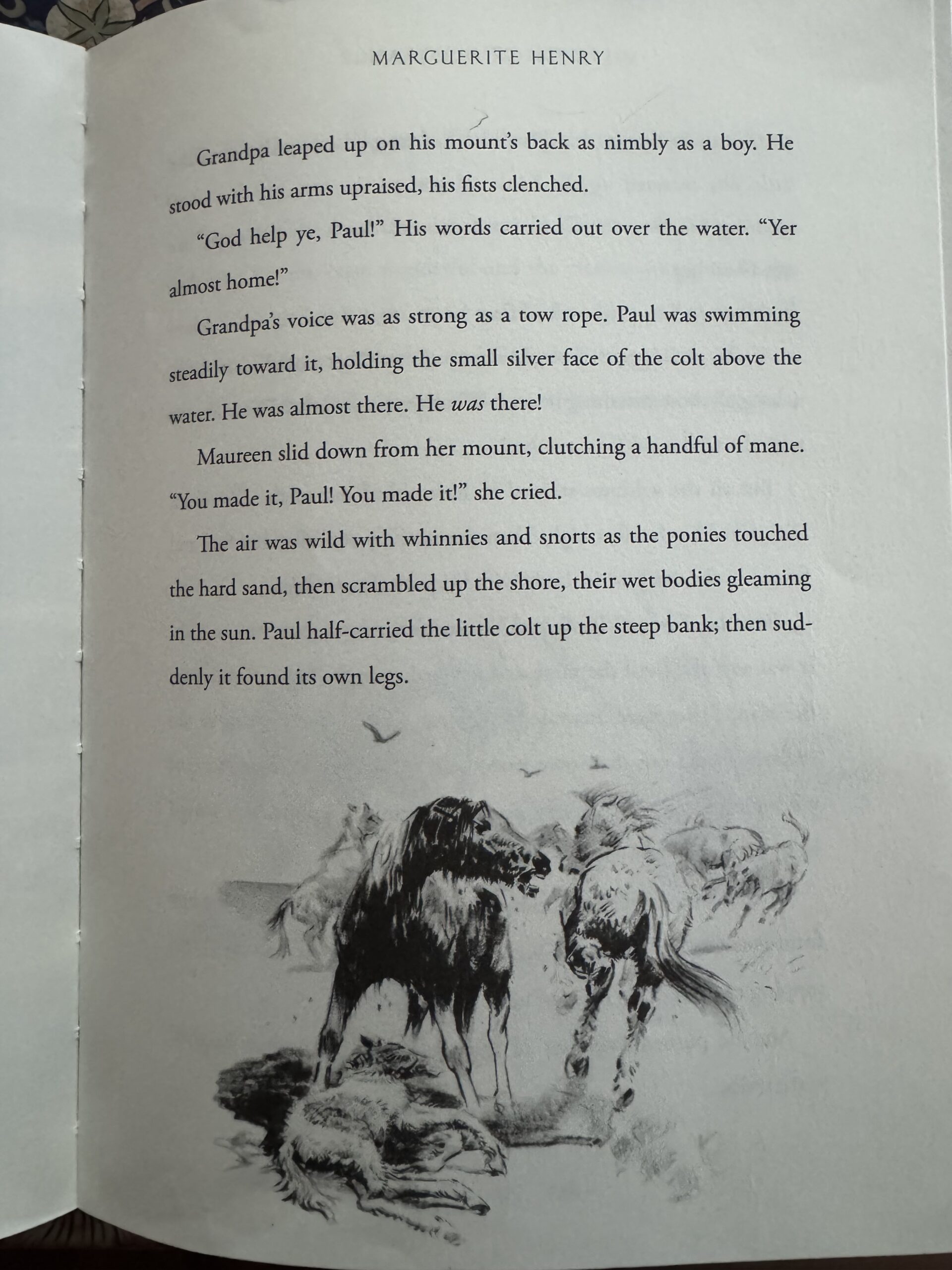
Then begins the work to break Phantom and to raise money to buy both her and Misty. . .
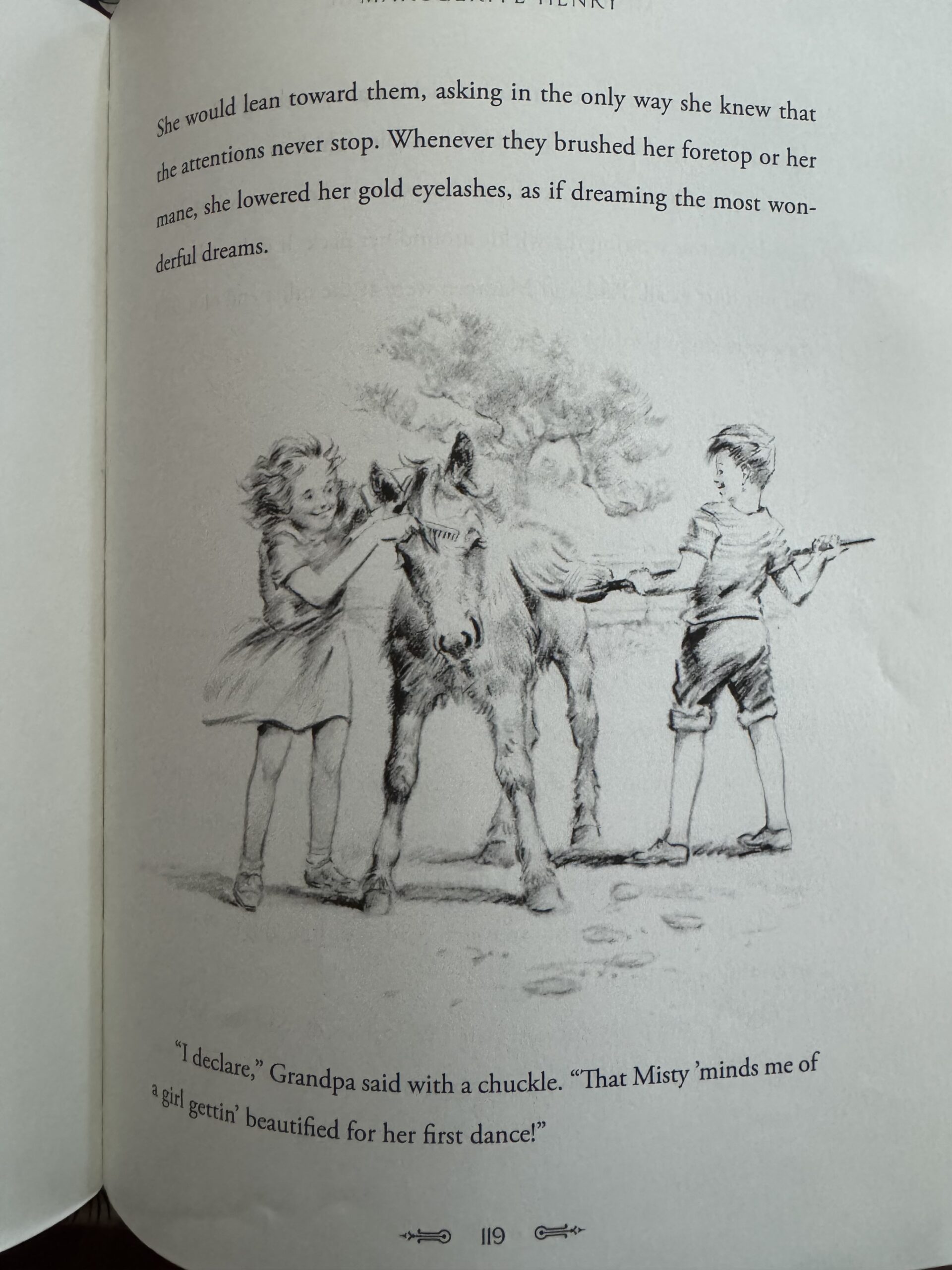
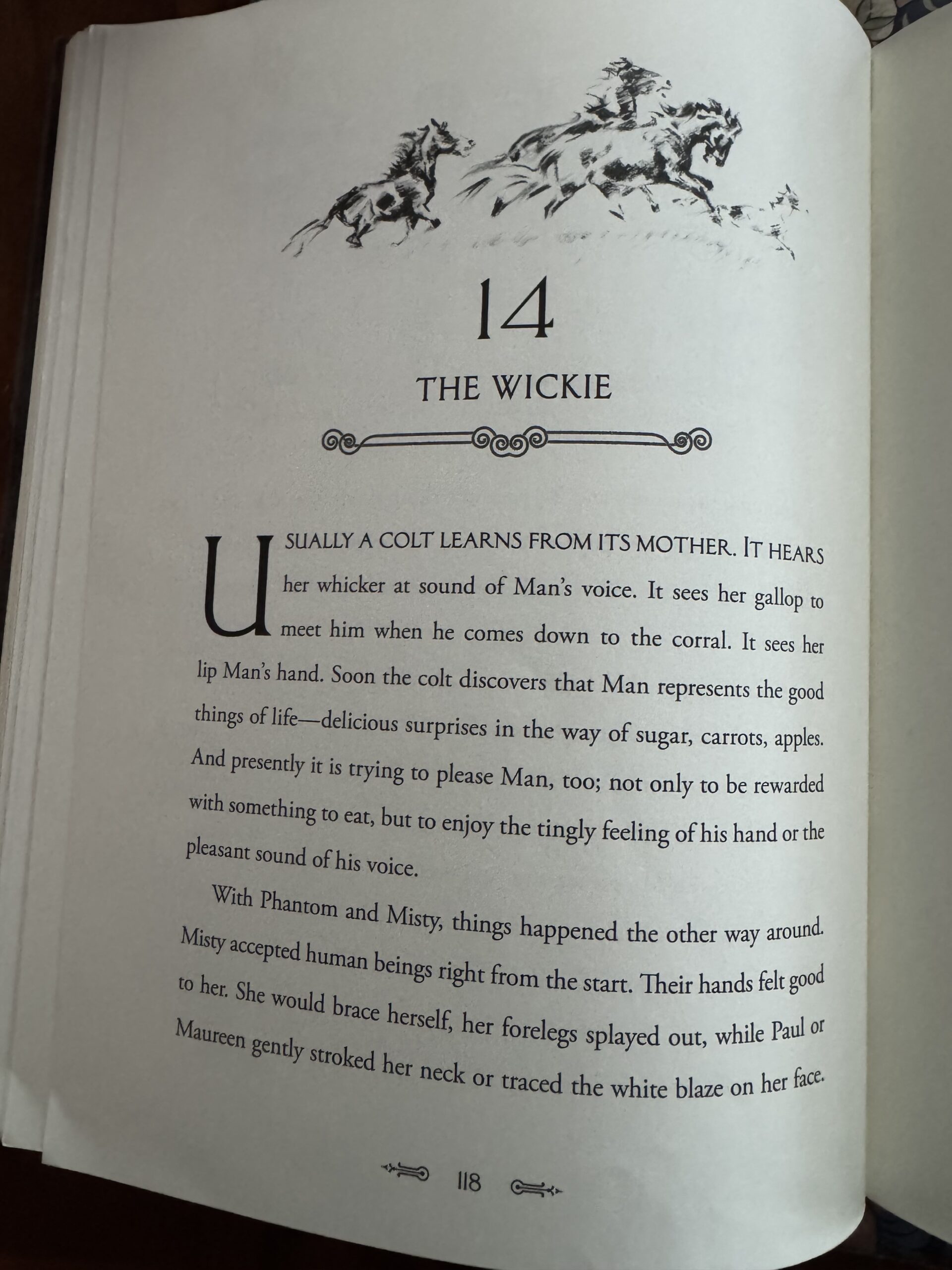
The siblings work hard to break Phantom, to ride her, and to buy her and Misty. . . . And they manage to raise enough money to do so, but then complications ensue. . .
As I read I was struck by how much language has changed in the eighty years since Henry wrote the book. And how it contains so many words I wouldn’t have known when I read it in the early 60s, but that I absorbed or ignored or deciphered through context, completely unconscious of enriching neural pathways as I delighted in story and language and rhythm and image. I do wish I’d re-read it earlier and thus been prompted to read it aloud to my grandkids when there were still ample occasions for doing so. Even now, I suspect that the history of the ponies and the Paul/Maureen narrative could still catch and hold their attention IF they had a bit of help pushing through the first quarter of the book — I have found that reading the first part of a book aloud so a young reader absorbs context, lexicon, etc. is a good way to hook them into a narrative that will then pull them along in their independent reading.
61. An Elderly Lady Is up to No Good. Helene Tursten. Trans. Marlaine Delargy. Short stories; Crime; Octogenarian; Humour.
A slim book (with a delightful cover, a mock-up of a cross-stitch sampler, embellished with hearts AND skulls & cross bones). I learned about this from the Sales Assistant in Murchies with whom I’ve made a habit of exchanging book recommendations as she fills bags of loose tea –my order of Editors’ Blend, London Afternoon, and Cinnamon Chai Rooibos teas.
All this elderly lady (the one in the book; not the one writing this post ;-)) wants is to be left in peace to enjoy the rent-free accomodation in a commodious apartment in a desirable building — which, on her father’s death, had been left to his widow and two daughters. Seventy years later, the elderly lady has outlived her family, and aroused the covetousness and greed of a foolish neighbour who thinks an old woman would be easy to trick. . .
In the course of several stories in this slim volume, Maud not only deals with that neighbour, but also meddles in the engagement of an erstwhile lover and rids herself of other, shall we say, “disturbances.”
Certainly upends any preconceptions about sweet little old ladies. I see there’s another volume since this was written. Have any of my readers here read either of these “Elderly Lady” books?
And thus I begin inviting your comments. Which of these books have you read, liked, disliked? Have you recently reread any favourite books from your childhood? Do you ever read children’s literature simply for your own enjoyment?
I’m also curious about which books you might have read that provide a perspective on a history or a culture or simply a voice that’s different from what you generally encounter. So often, I hear readers laud a book for being so “relatable,” and I understand that appeal, but so often the term seems to be applied to a book that is resonant with our own experience. Especially in times as challenging as these, there’s an understandable desire to turn to that comfort. But I think it’s also valuable to put ourselves in another’s shoes, to use that old expression, and books have always seemed to me to be a rich resource for facilitating that. Love to hear your thoughts and recommendations. Let the bookchat begin!
xo,
f

Your turn of phrase that somehow your circulation begrudges your fingers made me smile both in trepidation and sympathy – an excellent way to engage your readers. I am, as always, in awe of the variety and sheer number of books you read. I continue to struggle with reading and am lucky to read a book a month.
Our daughter (and only child) moved out of home this week into her first apartment. What a week! I miss her dreadfully, though we talk, text and see each other almost daily as we continue to help her transfer belongings that didn’t quite make it into the removal boxes. I was a little younger than our her when I left home and was thrilled to be free of the restrictions my traditional Greek parents placed on my comings and goings. She is happy, if not quite thrilled, with her move. It’s early days and we’re all adjusting. But I know it’s the right thing for her. And I want to see her blossom into an independent woman while I’m still around to watch. Nevertheless, it’s been a very emotional time, and very hard.
I felt a frisson of excitement when I saw Charlotte Wood’s name, as I always do when I see an Australian author included in your monthly readings. As luck would have it, The Weekend was one of my Covid era readings. I too enjoyed it very much and your observations and praise made me wonder why I haven’t read more of her books. I shall add more Charlotte Wood to my book list.
I’m currently reading A Bit on the Side by Virginia Trioli, an accomplished Australian radio and television journalist. It’s an amusing and erudite riff on the notion that “daily life, even the mundane moments, can contain the small joys that you need to live a happy life.” My pleasure in reading it is enhanced by its food focus, where side dishes are discussed and some recipes provided, so it’s a kind of food memoir with collected stories and wisdom.
Author
Pleased to have made you smile, Maria. Now I’m smiling as well!
Smiling, also, in thinking of your daughter in her first apartment. That sense of newness, possibilities, independence. . . but sending you hugs, because much as you want this for her, it’s tough on Mama!
Highly recommend Wood’s more recent novel Stone Yard Devotional which I wrote about not so long ago. I’m going to read more of her backlist, for sure!
I’ll look for A Bit on the Side — I like the sound of its focuses.
I’ve read a few of Helene Tursten’s Detective Inspector Huss books and enjoyed them, though they have a rather dreary feel to them, being set in the cold of Sweden. That sounds ridiculous… maybe dreary is not the right word, maybe “heavy” is better? In spite of that, I just ordered a secondhand copy of An Elderly Lady Is up to No Good because it sounds quirky.
I recently enjoyed The Readers of Broken Wheel Recommend by Katarina Bivald and The Tourist by Olen Steinhaver. A nearby thrift store with a nice selection of books had a four for a dollar sale on books and I came home with a very random selection. I’m so enjoying having books stacked everywhere! It makes this new-to-me house feel warmer.
Author
I think you’ll be entertained by An Elderly Lady — the stories are all short and you I don’t think you’ll feel the Swedish cold 😉
And how fun to browse in a thrift shop nearby, and load up on books at that price — Money is no object! 😉 Luxury shopping!
Reading and home decorating taken care of.
Thank you Frances,I’ve already bought Helene Tursten book ( when both you and one of my favourite authors -Peter Lovesay- enjoyed it,I’m really looking forward to read it),as well as Valentina Giambanco’s. All the other books look amazing,too
I’ll start with Katie Kitamura’s Audition,shortlisted for Booker 2025. It is a relatively short book,but oh so complex and deep and like a play in a novel in a novel. The narrator is an accomplished actress who,during the rehearsals for a play (where there are two different parts of the play that have to be connected) meets a young man who claims to be her son…and there is the second part of the novel,too (and a third,maybe), but no spoilers . Such a powerful but still an intimate novel,how we play our parts in life and how people we love (or not) see us,and vice versa. There is a short part about a famous actor who is loosing his memory and how it affects his performance……
Richard Osman’s The Impossible Fortune-aw,I like this series a lot,it is clever and funny (sometimes even Ionesco’s or Oscar Wilde’s like ) and a mystery
Tan Twan Eng’s historical novel The House of Doors,situated in Penang during 1920s,with fictionalized Somerset Maugham ( I’ve read Maugham’s books soooo long ago,without knowing all the facts about the author and his inspirations-now I even can’t remember them) and Sun Yat-sen . Enjoyed reading it,I didn’t know till now that it was longlisted for Booker 2023.
I’ve discovered Simon Mason at Sue’s High Heels…read Killing in November and The Woman Who Laught-new mystery author,love them-will continue ASAP
Started with Deborah Levy’s autobiography trilogy,Things I Don’t Want to Know
And one of my favourite Croatian contemporary writer Jurica Pavičić’s new book: Mouth Full of Sea,read in Croatian,excellent
Sorry,for a long comment,but I’ve read so many really good books in September and wanted to share
Dottoressa
Author
Dottoressa, again, so many books — never apologize for a long comment! We’re always keen to see what you’ve been reading, and there are a few here I want to add to my TBR list! The Impossible Fortune, of course, and Audition and I’ll have to check out Simon Mason as a mystery writer!
I’ve read Levy’s Things I Don’t Want to Know and The Cost of Living back in 2018 (I can remember by using search feature on my blog — I hadn’t yet begun keeping a written record of books read) and then Real Estate a few summers ago. I liked them very much and I’m sure they’d stand up to rereading now.
I checked right away to see if Pavičić’s new book (or any others!) have been translated into English. I really liked the one I read in French a few years ago — that was a very roundabout way of getting to read a Croatian writer!!
I also enjoyed The House of Doors very much and wrote about it, and also very much liked The Garden of Evening Mists.
I’ve been reading Frankenstein; or, The Modern Prometheus (the 1818 text). My daughter found it on her bookshelves (the apple doesn’t fall far from the tree!) and our discussions prompted me to have another read of it after probably 50 years. It is heartbreakingly sad; so much so that I’ve given myself a little break to gird my loins for the final chapters. I know more about Mary Shelley now and I’m sure I wasn’t thinking about her when I was 15 or so.
Other than that I’ve been watching more than reading and although my film classes aren’t formal I try to give the material a bit of thought. Night table reading is just whatever appeals from the bookshelves.
I saw a mention of Katherine Mansfield’s The Garden Party somewhere and I went to the shelves thinking I had a copy. I wouldn’t say I had an interest in her but I found three collections including at least one of her stories and a WHOLE BOOK of which I had no recollection at all. How does this happen??
Author
Oh, it’s SO long since I read Frankenstein — I remember how satisfying it was to find out that the name “Frankenstein” referred to the man who made the monster, rather than to the monster itself. And then the satisfaction of recognizing that, in fact, the man was more monstrous than his creation.
Mansfield is a writer who was culled from my shelves a few years ago — the anthologies I had were survivors from grad school courses and I knew I could always find copies at the library around the corner. . . But if I’d kept them, as you did, I’d be able to read a story of hers now. Instead of possibly resolving to, but then not ever, squeezing her name onto a TBR list and getting a book from the library.
btw, although this is obviously a conversation about books here, I think we could also support the occasional recommendation from your film classes, should there be a standout.
You will not be surprised that I was thrilled a emotional when reading your review of Misty of Chincoteague. I do not have my childhood copy, I likely read a library one. I do however have Henry’s Album of Horses, gifted to me by my parents in 1951 when I was ten. Also illustrated by Wesley Dennis with beautiful full color illustrations of each equine breed, including the Chincoteague Pony and the beginning of a lifelong obsession. And I do own my own “Misty” copy now.
Quite a few few interesting suggestions. We Measure the Earth With Our bodies seems like it would be ideal for my global book club, but there is often the problem of not being able to obtain enough copies here in The US . The Alice Madison series also seems like it would hit my literary sweet spot for pleasurable reading but wondering about availability. I have read the Tursten novel for book club a while back. The Weekend is another which I will look for.
Currently reading The Sicilian Inheritance by Jo Piazza, a novel about a woman who goes back to her family’s town in Sicily to possibly reclaim land, and becomes involved in murder, intrigue. Maybe a bit implausible but so far a fun read. Also read Nesting, Roisin O’Donnell, an Irish writer. A riveting tale of a mother trying to escape an emotionally and potentially dangerous marriage and make a new life for herself and her children. A Fashionable French Murder, Coleen Cambridge. mystery. Ok. The Great Gatsby, F. Scott Fitzgerald, The American classic, reread for a book club, and A Girl Returned, Donatella DiPietrantonio and translated by Ann Goldstein. Italian and winner of several awards. fiction, coming of are. A 13 year old girl is suddenly sent to live with her alleged birth parents of which she had no previous knowledge. they live in raw poverty while her former circumstances were much more comfortable. She does not even have her own bed. She must cope with these changes which include the sexual advances of her new “brothers” while dealing with her own emerging sexuality. I was wondering if you may have read this one, which if you did it was likely in the original Italian.
And now I am going out to do my own bit to combat fascism, planning to participate in a protest in a nearby town. I could never have imagined that at this point in my life this would be the reality.
Author
I’m so pleased you inspired me to read the book again and enjoy the illustrations, so many decades later! Thank you!
I think/hope We Measure the Earth with Our Bodies might be more easily available in the US because it was chosen a couple of years ago as an NYT Summer Reading Club book. Not sure about the Alice Madison series.
You’ve been another busy reader already this fall. I haven’t read L’Arminuta (A Girl Returned, but our Italian Book Club has been reading through Strega winners, and I see the author was awarded that last year. I’ll look forward to reading it eventually.
Finally, Brava and Thank you to you for getting out there to be visible and noisy in favour of democracy, against the threat of fascism!
I read many of Marguerite Henry’s books as a horse-crazy child, but Misty of Chincoteague was my absolute favorite. Thanks so much for reproducing some of the pages with their lovely line drawings! Currently I am reading Doris Kearns Goodwin’s An Unfinished Romance and thoroughly enjoying her close and personal look at the 1960s in the U.S.A. Highly recommend it!
Author
Aren’t the illustrations wonderful?! It was such a pleasure to sink into that book again — glad to know others enjoyed those books as much as I did!
Not familiar with the Doris Kearns Goodwin’s book, but thanks for letting me know about it!
I might suggest wood’s other book..stone yard devotional. Reading some totally light chalet series stories interspersed with Japanese murder mystery
Thanks for the comments on we measure that land..it’s on my holds list at the library.
Author
Yes! I read Stone Yard Devotional a month or two ago and wrote about it here. Thanks for reminding others about it, definitely worth mentioning again.
I have just finished R.F. Kuang’s Katabasis. I don’t know what genre I would call it. Having spent many years in a university setting in one capacity or another the setting of hell as a university campus and her descriptions of some of the characters resonated. (I should maybe add that my personal experience was mostly positive and I loved being part of the university community)) It’s not as fast-moving or as gripping as Babel, but I would recommend it.
I am currently reading The Garden of Evening Mists from your April list. I’ve been to Malaysia and have friends who retired there, so I am particularly enjoying the interplay between the various ethnicities and the historical bits. I will be looking for more from this author. Thank you!
Author
My daughter just recommended this one to me as well, Gisele. I’ve spent many years on university campuses as well — and I’ve enjoyed both Babel and Yellowface.
I’m glad to hear you enjoyed The Garden of Evening Mists. See Dottoressa’s comment here about another book by the same author.
The Weekend is now on order from the library! Thanks for the recommendation.
Author
You might like the author’s Stone Yard Devotional
I first read Misty of Chincoteague as an adult and thoroughly enjoyed it. I do like to reread children’s books from time to time, although I am sometimes surprised how dark some of my favorites were – Harriet the Spy comes to mind.
This month I have been binge reading detective books, including rereading some of Louise Penny’s Armand Gamache books in preparation for her new book which is coming out soon. Those books are like comfort food to me despite the nasty crimes, I think because I love the characters and appreciate the larger themes Penny explores.
As usual I have jotted down some suggestions to request at the library – thanks everybody !
Author
Yes! I was surprised at how much darker Harriet the Spy was than I remembered. Lots to discuss when reading it to a granddaughter last year.
Interesting to hear about North American pony books. As you can imagine, it was a rich seam in British children’s literature, including much about the rather upper class Pony Club. The Pullein-Thompson sisters wrote 150 books among them. https://collections.reading.ac.uk/special-collections/collections/christine-pullein-thompson-collection/ My favourite pony books were by Monica Edwards, because of her wonderful sense of place in her two settings of the Devil’s Punchbowl in Surrey, and Romney Marsh, on the Kent coast. Unlike many pony books, hers are beautifully written and the seasons and human relationships acutely observed.
My reading this month has been:
Travelling to Work – Michael Palin’s Diaries 1988 – 98, covering the period when he started making the world travel programmes for which he gained (more) fame
Le Gardien du feu, by Anatole Le Braz. A book for my online French class. Set in Brittany of the 19th century, a chilling tale of revenge for betrayal in love. Set in and around one of the lighthouses that dot this dangerous coast.
Crooked Cross, by Sally Carson (Persephone Books). Also chilling – a 1934 novel detailing the rise of Nazism observed through an ordinary German family. Chilling in its relevance to the creeping fascism and “othering” seen in the extreme right movements in Europe and America today, and how ordinary people go along with them until it’s too late. Recently a BBC 4 Book of the Week. Good review in The Guardian https://www.theguardian.com/commentisfree/2025/oct/18/crooked-cross-hitler-1933-novel-sally-carson
The Past is Myself & The Road Ahead, by Christabel Bielenberg. Life in Germany during WW2, by a British woman married to a German lawyer. He was on the fringes of the plot to assassinate Hitler, and was imprisoned as a result. The Road Ahead tells of their post war life.
The People’s War, by Angus Calder. Massive tome about every aspect of life in Britain during WW2. The best book I’ve read on the social and political history of this period (and I’ve read quite a few!), looking beyond the clichés of “cheerful Cockneys emerging smiling from bombed houses” and everyone pulling together for the war effort. It lays bare just how appallingly hard life was, how unprepared the Government was for the coming war, how it continued to get it wrong on the domestic front, and how close we came to defeat.
Ottoman Odyssey, by Alev Scott. A contemporary journey through countries formerly part of the Ottoman Empire, by a journalist who is half Turkish but banned from entering Turkey after writing critically about aspects of Erdogan’s regime. What hugely complex history in this region (and what a mess the Allied powers made of it after WW1). I saw it mentioned on one of the random notes that pop up on Substack – not many of these lead in interesting directions and I block any that are on subjects I really came to Substack to avoid, but this one was useful!
Author
So much here, Linda, thank you!
From my limited experience with British children’s literature, I’m going to hazard that they’re very different from the Chincoteague books — a comparison would make an interesting research project 😉
I vaguely remember beginning “the Weekend” a few years ago and never finishing it. As far as I can recall I did not really relate to the protagonists, finding them very stereotyped. But perhaps it was the wrong moment. I may try again some time. This past month I started “A House in the Mountains”, but had to stop half way through because I had decided to give it to my sister as a birthday present. I will wait for her to read it and then borrow it from her to finish it. ‘I also read “Stolen Pride” by Arlie Russell Hochschild. She explores Appalachia in the same way that she did with Lousiana in her last book (“Stangers in their own Land”). Very inspiring, although not really encouraging.
Author
Charlotte Wood’s writing takes some time to enter, in my limited experience, but I don’t find her characters stereotyped. It does take a while, I’d agree, to see the characters revealed. And her writing won’t appeal to everyone.
Clever gift-giving strategy there! When I worked at a bookstore many years ago, I learned that many readers who liked giving books as gifts, took it as their obligation to read a book first (very carefully, No food, No water nearby!) to make certain, right to the last page, that it would be suitable for the recipient. So generous of us, no?