August blurred past, at least in our home. . . .It must have lasted long enough for me to read a stack of books
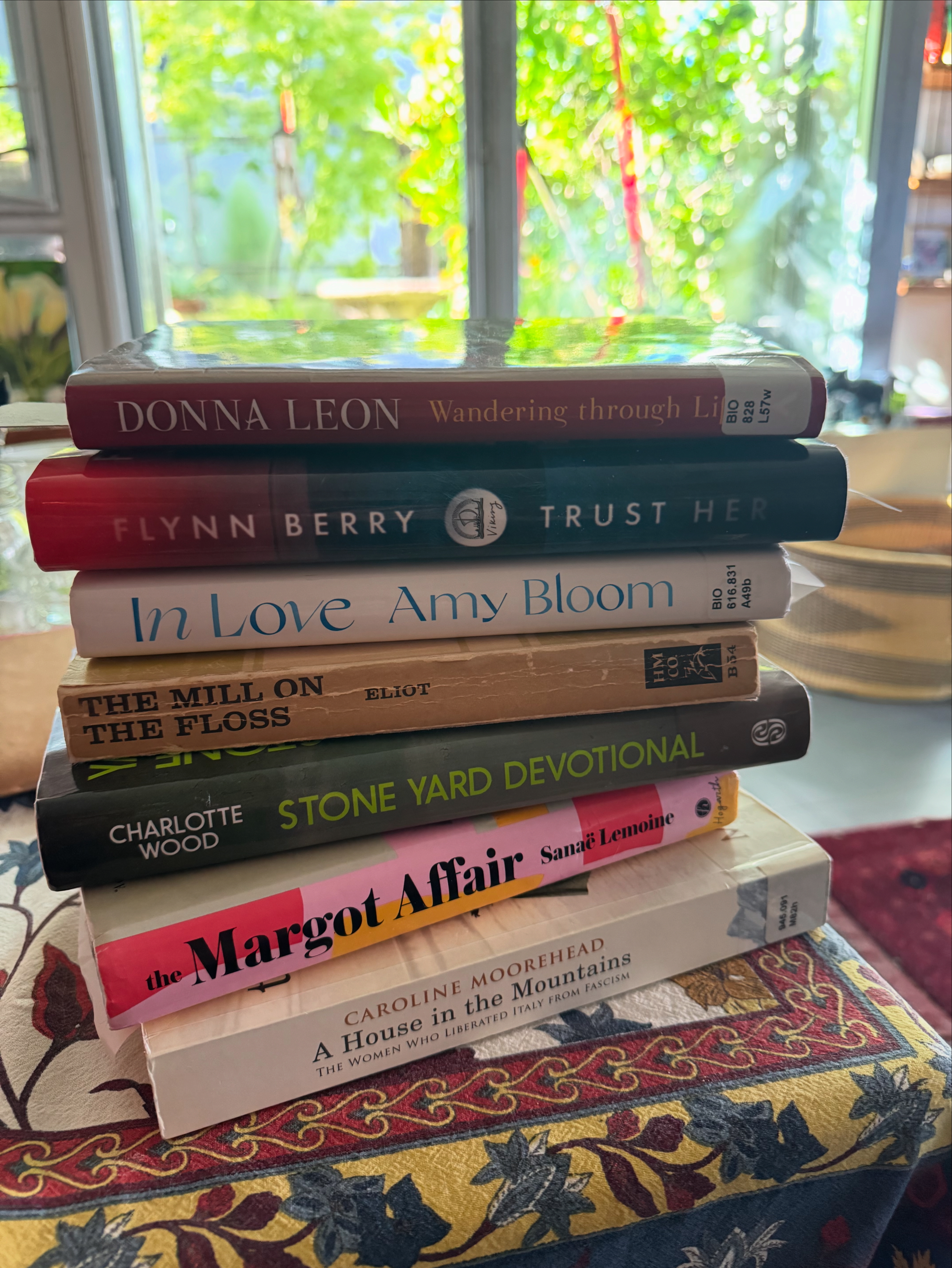
and there was a week or two with a guest dog, and there were workers coming and going to install a heat pump system, others following to repair holes in the dry-wall and then to repaint the repaired wall. But the way September quickens our pulses, seducing us into that small catalogue of “ber” months (Brrrr months, really!), August memories are receding for me and the notion of one more ocean swim is being put away, as should be my Birkenstocks and summer dresses.
And I’m almost ready for woolens, perhaps partly because I just finished this little vest. I don’t usually share photos of my knitting in my bookposts, but thought some of you might not mind, given the readerly theme. . .
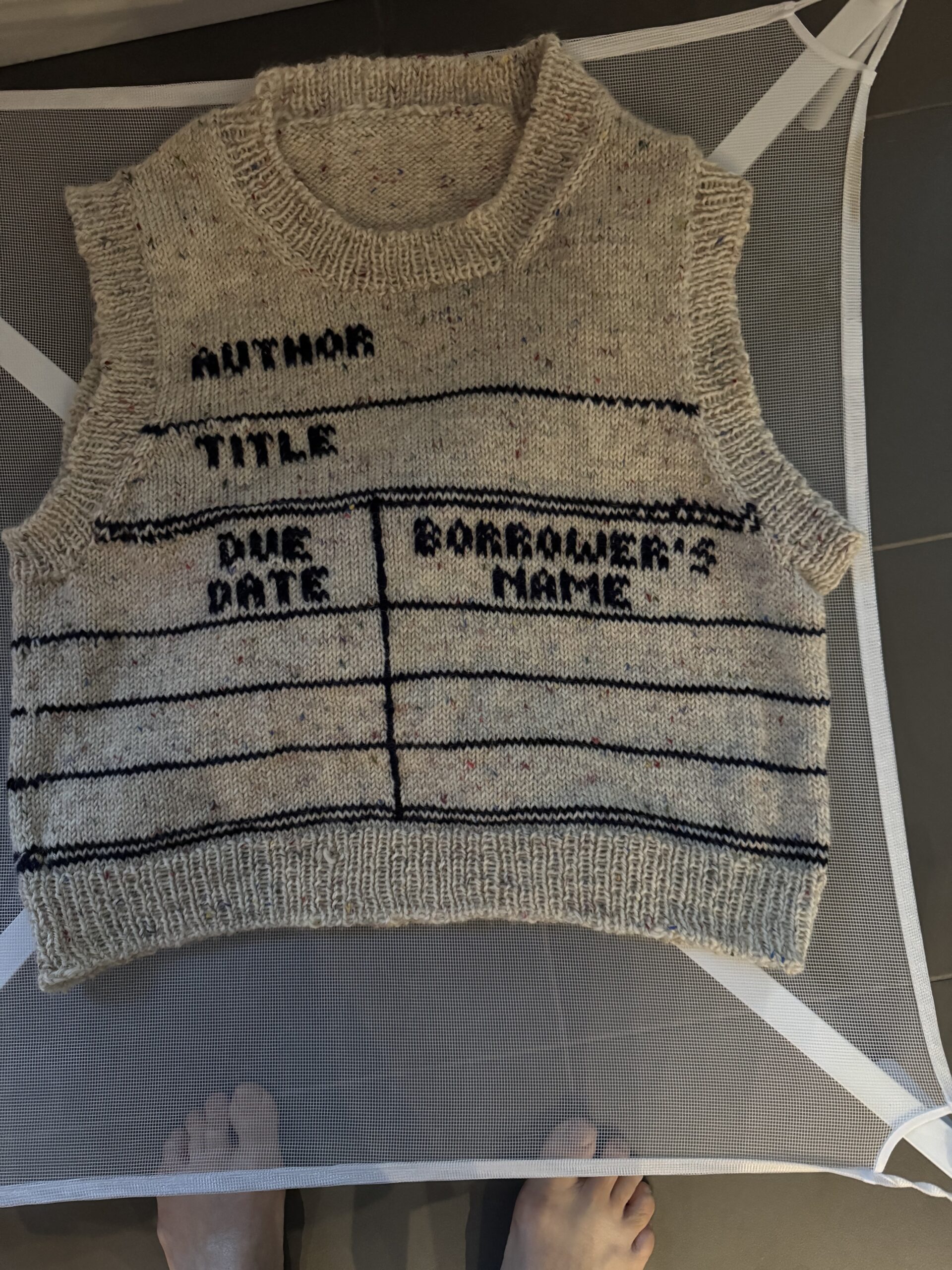
There’s a photo of me wearing my Library Card Vest in my latest Substack post; should you crave your own Library Card Vest and be willing to spend some time with needles and yarn, you’ll find the pattern on Ravelry.
Now, onward to the August reading, after this regular reminder: As usual, the numbering comes from my annual handwritten reading journal, and the italicized text below is directly transcribed from that journal’s pages (once upon a time, I simply included photographs of those pages, but too many of you found my handwriting tough to decipher, especially in the photographed format). Notes to myself, that is, so that I can remember a book and remember my response to it, rather than any attempt at a more polished, edited review.
I’ve used regular font for any additions to my journal notes and included references to any posts from my Instagram Reading account.
45. Strange Sally Diamond. Liz Nugent. Mystery/Crime; Psychological Novel; Set in Ireland; Irish writer.
The “summer reading” choice for a book club I’ve been attending that features Irish writers.
Bold, startling, opening pages. Sally lives with her aging father and caretakes for him, and when the novel begins, he’s told her that when he dies, she shouldn’t make a fuss but simply put him out with the garbage. Why he would say this, as a psychiatrist who knows that his adopted daughter interprets speech literally, is a question that lingers long after the reader watches Sally do just as her father has instructed. He dies in his bed a few days after these glib instructions . . . and she attempts to burn his body, just as she burns other garbage in their large back yard, at some distance from the nearest village.
And when this proves more difficult than she’s imagined and asks for help, first the police arrive and we learn more about Sally’s background: that she was adopted after being rescued, age about 7, along with her mother, who’d been captured at 11 and held for years as a sex slave. Any memories Sally has from this period have been suppressed, but the descent of the international press initiates a series of events that see her learning mmore about her background. At the same time, having to navigate without her father’s guidance, she begins moving into community, learning to trust (or not), learning to moderate her social responses.
While this story is unfolding in Ireland, we also follow the path of her biological rapist father to New Zealand.
A gruesome foundation (child kidnapping, sex slavery) but well-plotted and compelling in its psychological explorations. The book led to a lively discussion by those of us gathered around a large table overlooking a grand view of Vancouver’s Coal Harbour.
I mentioned Strange Sally Diamond on my IG reading account, and author Liz Nugent actually popped by to comment! I love it when authors take the time to connect (even if they might have a publisher’s intern do that 😉
And I wrote a bit about Liz Nugent’s earlier novel Lying in Wait a few years ago.
46. The Art of Uncanny Prediction. Detective/Mystery novel; Female (Private) detective; Set in Japan; visits California; Historical fiction; Japan end of WWII to near-present.
Paul got this from the library and enjoyed it enough to pass it along thinking I’d like it as well. I actually read it a month or two ago, and then forgot to make a note in my reading journal. Was only reminded by a photo I’d taken
Set in Japan and with a foray into California. The book begins in Tokyo during the firebombing at the end of WWII; a teenaged boy is helping his master escape with important records that the young man suspects are linked to blackmail. The master meets a slight shove while in a precarious position, and the boy is free of servitude and blends into the chaos of the time.
Decades later, private detective Umiko Wada, single in her personal life and single owner of the Kodaka Detective Agency, is asked to track down a business man’s estranged son and discovers links to a 25+ year-old investigation by her late employer, the man who gave his name to the Kodaka Detective Agency before he died and left it to Umiko.
There are several other volumes in this series and I’d try another to follow the development of Umiko’s character as well as that of the disgraced sumo wrestler Umiko’s difficult mother has taken under her wing. I’d read another, as well, for the setting and for the good writing, but the plot twists that other reader have reviewed enthusiastically left me dizzy and fatigued. . . and, honestly, impatient. Obviously, you should take my opinion with a big grain of salt.
47. The Mill on the Floss. George Eliot. Literary novel; English Literature; Victorian Literature; female English writer. Coming-of-age novel. . . and so much more!
On the recommendation of my Victorianist friend and ex-colleague, S., as a more enjoyable Eliot novel than Middlemarch! Only recommended because I was foolishly inspired by her summer project of reading Moby Dick to wonder if I should make this the summer I reread MM. . . . Which is when she said . . . and then, since I’d had a used copy of The Mill on the Floss on my shelves, unread, for years. . .
So much of this that I enjoyed, even so much of that 19th-century prose full of long sentences, cleverly twisted syntax, so many subordinate clauses . . . and deliciously arcane vocabulary (arcane, even esoteric, because we’ve allowed so many words to fall into disuse).
And the wry, arch humour (especially at the expense of Mrs. Tulliver’s sisters and their husbands, their middle class aspirations). Then the narrator/Eliot’s progressive ideas about education, the observations about industrialism’s impact on the English countryside . . .
Both Tom’s obdurate righteousness and Maggie’s impulsive tendency to “cut off her nose” (her hair, in fact) “to spite her face,” as the saying goes. And then her response (having little to no helpful guidance in how to be female — which at the time meant “feminine” in very specific ways — in that society, without surrendering her own selfhood completely) of moving between absolutes: complete abnegation of her own desires and submission to a narrow spiritual code OR finally allowing herself to feel.
Of course, disaster ensues . . .
And I cannot reveal the ending for those few who may go on to read this canonical text. I will say that I was very annoyed at it, frustrated, considered it a wicked reward for a reader who’d persevered through all! those! words!
Although after conversations with my Victorianist friend, I conceded that there were few credible options for a woman like Maggie at the time. And also, as S. pointed out, sensation novels were rather marketable at the time and Eliot did have to earn a living. . .
48. Stone Yard Devotional. Charlotte Wood. Literary fiction; Women’s lives; Spirituality; Psychological fiction; Elegiac; Australian writer.
Short-listed for the Booker and recommended to me by a reader, either here on on Substack.
A woman in her 50s disillusioned with her work as conservation specialist, a sometime activist, facing the break-up of her marriage, has come to a small community of nuns near the small town where she grew up, on, as the book jacket says “the stark plains of the Australian outback.” She’s retreated here for respite from her life, to give herself time for, perhaps, discernment. She’s not religious, nor does she leave much room for spirituality, and she’s clear that she doesn’t believe in God. But she’s surprised to find herself intrigued enough (the aesthetics of the music, the simplicity, the soothing rhythms of daily ritual) that she returns after that first visit, to join the community of women (mostly aged).
As she allows her daily life to be ordered by chores (she takes on all aspects of food acquisition, storage, and preparation) and by prayers and periods of silence, she also remembers her childhood, her parents’ inspiring and foundational mythology, her Catholic school, tempered by her mother’s unorthodox spirituality (although her mother was Catholic by birth). The schoolgirl who the narrator recalls — with shame — being so horribly treated by her classmates, and who returns to town, as fearless and intimidating and seemingly defiant as the narrator remembers. And that grown schoolgirl continues the environmental activism the narrator has abandoned in despair, so that the narrator is doubly ashamed, determined to figure out how to apologize, how atone.
A slow burn of a book. There is a plague of mice, a quiet steady horror that coincides with the return of a former community member’s bones, the call for those bones to be buried on the nuns’ property, requiring bureaucratic hurdles to be overcome. And layers and layers of the past being unveiled in small anecdotes, a kaleidoscopic revelation or perhaps, rather, a jigsaw puzzle being emptied on a table top for a reader to put together.
Beautiful, lyrical, attentive, and concretely descriptive writing, full of significance, numinous, weighted yet translucent..
You can read The Guardian‘s review here.
49. The Margot Affair. Sanaë Lemoine. Literary fiction; Coming-of-age; Mother-Daughter; Set in Paris.
17-year-old Margot lives with her mother, a celebrated Parisian stage actress about whom Margot has more than a normal adolescent ambivalence. She loves her mother “with abandon,” knows that “she made sacrifices for me” and also that “motherhood clashed with her self-realization.” She deeply admires her mother’s physical grace, charisma, talent, but responding to her mother’s cultivation, as M. sees it, of distance between them, she takes to calling her by her name, Anouk, rather than Maman. She says, “Anouk, on the other hand, ended with a sharp edge, and when I yelled her name, it was like throwing her over a cliff.”
All this in the first 5 or 6 pages, setting up a context and central theme of the novel. M’s mother, Anouk, conceived her in an affair with a prominent politician, a married man with children. He has always been in M’s life, visiting somewhere between regularly and periodically, generally at his discretion — and while she loves him and feels secure in his love for her, a sighting of his wife, pointed out to M. by her mother, sets in motion a struggle by Margot to understand and respond to the secrecy that she and her mother guard on his behalf.
And then at a party she meets a journalist — suave, mid-30s, good-looking — and, flattered by his attention, she drops a hint about her father’s identity. Soon, she is befriended by the journalist and his attractive wife, who seduces Margot into telling them her story, the repercussions of which she hasn’t anticipated.
The food writing in this novel — speaking of seduction! Note that the author has also written and edited cookbooks. . .
but honestly, I squirmed reading this at times, didn’t know if I could continue. The exploitation of M.’s adolescent, brink-of-adulthood, desire to be seen, heard, and, yes, desired; the naiveté of her faith in her own maturity: So, so manipulable!
Worth my getting past that, the ending is “redemptive,” with surprises, development of M’s relationship with Anouk. etc. And Paris as setting, as urban geography we happily recognize, but also as a cultural and social milieu.
Recommended, with that “squirm” proviso.
50. Sweet After Death. Valentina Giambanco. Mystery/Thriller; Police Procedural; Alice Madison Series; Female Detective; Set in Seattle; Pacific Northwest.
Paul passed this on to me, one of his almost random library finds that he thought I’d like. Wasn’t sure for the first few chapters but soon got over my reservations. Turns out this is the fourth (what I mean by his “almost random library finds,” that he would pick up a fourth volume and start there!) in the Alice Madison series, set in the Pacific Northwest where Alice is stationed in Seattle. In this volume, she and a very small team are sent to a small town in the mountains (in winter) where the loal police force needs help to solve its first-ever murder. Under-resourced, unused to the severe cold and the isolation, the team is soon faced with another murder and the town riddled with fear and suspicion.
And Alice has a secret, a relationship with a powerful Seattle lawyer that she doesn’t quite know how to classify yet . . . and she makes allusions to a troubled childhood, to earlier cases . . . so that by the time I got to the last well-written page of this cleverly plotted mystery, I was intrigued enough by this detective and by her colleagues that I wanted to go back to start at the beginning of the series.
Recommending this one, but do what I should have done and start with the first, The Gift of Darkness (#53, below).
51. Wandering Through Life. Donna Leon. Memoir.
I hoped for more from this, a memoir that would be more candid, possibly revealing something of her private life and, perhaps, even something of what it’s like to be in one’s 80s, some thoughts about aging. There is some of the latter, but what there is can be summed up as “Well, sure, the wheels start to fall off [she actually uses this expression, quoting a friend], but if you keep fit and practice a healthy lifestyle, you can maintain a good quality of life.” Which is true enough, and fair, I suppose. She also offers many anecdotes from childhood, university, travel, meetings, and friendships with interesting people. But each chapter is like a magazine article, very contained. More as if a publisher suggested an obvious money-maker that would nicely complement the library shelves of Brunetti mysteries and be easier to write? Still have no idea if she was ever, for example, in love and somehow that seems relevant to me when writing about “wandering through life.” Especially since Brunetti’s relationship with his wife, Paola, is so much at the centre of her series’ success.
But maybe I’m just nosy. At any rate, a pleasant enough book if you can borrow it from your library.
52. In Love: A Memoir of Love and Loss. Amy Bloom. Memoir; Love; Marriage; Dementia; Assisted Death.
Can’t remember where I saw this recommended, but I suspect it might have been one of the commenters on the blog. Thank you, whoever you are!
I haven’t read anything else by Amy Bloom, but I would after this. It’s not easy to read — about the slow descent of her husband, Brian, into Alzheimer’s and his decision to die while he still retains a sense of self, an awareness of those he loves. And, even more, about Bloom’s commitment to find him a way to end his life with dignity and peace. After weeks of internet research and consultation with friends and experts, the Swiss organization Dignitas emerged as the only legal and painless option.
Bloom writes with love, sorrow, humour, pragmatism — and honesty. Not only about their final trip together, to Switzerland, but also about their meeting, falling in love (while both were in other relationships), marrying in their middle age, about grandparenting together, fitting into each other’s families. And also about dealing with medical professionals, wrestling with her gradual, pre-diagnosis awareness of Brian’s small lapses in cognition, her frustration with a system in which so much of what they were experiencing fell between the cracks.
And the helplessness of trying to find a legal way to help her husband even while dealing with her own exhaustion and grief. . .
Read with kleenex at hand, but it’s also funny, thought-provoking, and even inspiring.
53. The Gift of Darkness. Valentina Giambanco. Mystery/Thriller; Police Procedural; Alice Madison Series; Female Detective; Pacific Northwest.
The first in the Alice Madison series, and both Paul and I agreed it’s top-notch for plotting and for several characters. Madison is just starting out in Seattle PD Homicide, paired with an experienced partner whom she quickly learns to trust. The book begins with a horrific crime and suspicions quickly turn to someone with childhood links to one of the victims and to that victim’s colleague. The colleague, though, is also this prime suspect’s lawyer and is adamant that his client is innocent.
Complications? The suspect/client, the victim, and the colleague/lawyer’s younger brother were all kidnapped when they were 12, and the lawyer’s brother died during the kidnapping. Addison doesn’t trust the prime suspect but remains as open as possible; thus, considering the evidence, she and her partner begin to suspect another — yet unknown — killer. Meanwhile, someone has been sending messages that count down from an initial “13 Days.”
Before the novel’s over, many gripping scenes, tense moments, glimpses of a hideous imagination, of the long weight of the past, and also of heroism, nobility, and sacrifice in various forms.
Highly recommend this series.
54. Trust Her. Flynn Berry. Mystery/Thriller; Terrorism; Ireland; Sisters.
A follow-up to Berry’s earlier thriller Northern Spy which I read a few years ago. The two sisters whose involvement with IRA (Tessa’s very reluctant, compromised by her sister, Marian) meant they had to leave N. Ireland, are now living in Dublin under new, assigned identities. Tessa’s son is now in school, and Marian has a 6-month-old. They have jobs, a few friends, and Marian has married. Tessa still misses her old life but is grateful to be safe, to have re-settled, to have a job, to have her son in school. But that all changes when she’s kidnapped, threatened, and ordered to track down her old M15 handler and turn him into an IRA informer. . .
What wouldn’t we do if our loved ones were threatened? This is the question that drives the novel from the outset, and it’s powered by the relationships Berry sketches between sisters, between mothers and children, between lovers, and, especially in the Irish context, between generations, in a country where the history of violence and conflict weighs so heavily in the present.
Tense, thoughtful, compelling. (I’ve liked all her books.)
And that’s it for my August reading this year. Now the book chat can begin, and I hope you’ll share what books have caught your interest, have challenged or informed or entertained you. Made you laugh, made you cry, made you throw something across the room. Mostly, we all await those recommendations you so generously make, the ones that make it impossible for us ever to reach the end of our TBR list!
Comments open below; you know what to do 😉
xo,
f

Frances,I hope that everything went well and it is over by now
I’ve read Strange Sally Diamond.
Both Wandering Through Life and Stone Yard Devotional were (and still are)on my TBR list. I’ll have to start with V. Giambanco like Paul,with the third book,there are no digital formats of the first two in series avaliable here
August was seaside and Vienna coloured reading (I’m usually surrounded by my dearest people and there is no time for me-time)-easy and not a lot of it
But,to start with a serious one:
Han Kang’s The Vegetarian. Han Kang,South Korean author has won both 2024. Nobel Prize in Literature,as well as International Booker Prize in 2016
(both as the first Korean language novels to win the prizes)
Deborah Smith,as a translator,won the Booker as well
During her literature studies,Han was obsessed with a Yi Sang’s poem,part of which is “I believe that humans should be plants”- it might be an inspiration for The Vegetarian,the three-part novel. It is a visceral,extreme,bizzare,both violent and peaceful at the same time,cruel and devastating….and refusing,not understanding and not allowing different opinions, is very contemporary today
Lucy Clarke’s One of the Girls is a twisty thriller,a story of a bachelorette trip on the dreamy Greek island ,where nothing is as it seems.
Angela Marson’s Deadly Cry-I follow Detective Kim Stone and her team series
Jean- Luc Bannalec’s (real name Jörg Bong) Death in Brittany,the first one in Commisssaire Dupin series (it was lovely to read about Brittany) and Agatha Christie’s Cards on the Table (re-read ,one of her books I don’t like a lot) were the books bought at the seaside,we had not a big choice there and I was the only one reading digital books,so we’ve had to buy more “real” books
Susie Dent’s Guilty by Definition was one of the recommendations (and thank you to the reader who has recommended it,I simply can’t find who was the first one to mention it,maybe you)- I’ve liked it a lot
M.W. Craven’s The Final Vow-it is not the final,hopefully,and this is the only spoiler from me here 🙂
Dottoressa
Author
You read so much, K!! (And I’m glad you got time at the seaside — also, how lovely to be “surrounded by dearest people” even when that leaves us “no time for me-time”! Although then I need weeks more for catching up with myself when I get back home 😉
I read The Vegetarian a few months ago and wrote a bit about it in my June Books post, but I didn’t know about the author’s obsession with that poem. I agree with all your adjectives. It’s such a strange and compelling book (And I’m very pleased to know that the translator won a Booker as well.
I haven’t read anything by Susie Dent so can’t claim credit for recommending it, but now I’ll put it on the list 😉
And thank you again for the reassurance about our much-loved detective duo!
Aw,sorry Frances,I’ve find your review of The Vegetarian again now,it must have slipped my mind
It was on my TBR list since last year,but I didn’t like the description and have it postponed
This summer I’ve met a lovely young South Korean woman ( actually,she is my DIL’s family now, so mine as well :)). She was astonished to find out that a woman of a certain age from Croatia- me- has read and loved a couple of South Korean authors ,and she was full of praise of Han Kang….nevertheless,not a light read at all
Dottoressa
Author
Funny, because I thought I’d heard of it from you — maybe you mentioned it was on your TBR! I’m sure that young woman would have been very impressed — and delighted — to know there are readers like you in the world! (and we should all be so grateful for those who translate so that we can access ideas across cultures and languages!
BIG fan of the Eliot, the Wood and the Bloom. (I may have reco’d the Wood?) Greater minds than mine can find the parallels.
Author
Might very well have been you who recommended that one. And hmmmm, hadn’t started think of parallels, but yes. . . women’s lives and marriage and not-marriage. . . and also an interesting sample of structure/style to support telling of those lives . . .
I have not posted my reading list in a while. while I am a fan of Donna Leon Inspector Brunetti novels I started her memoir but then never got into it, returned it mostly unread. A while ago I had read Amy Bloom’s In Love. Recently read her novel I’ll be Right Here. A brother and sister, Algerian immigrants by way of Paris make their way to the US after WWII. Here they befriend 2 sisters, Over the years this group couple and uncouple in various and unexpected , unconventional ways. They experience both joy and sadness, love and loss as they enter into and embrace the 21st century.
I read The Last book Party, Karen Dukess for a book club. fiction set in the later 1980’s. Budding young woman writer takes a job on Cape Cod with a famous journalist, Life lessons are learned. A local author, which we often chose for our selection at this book club.
The Woman in Suite11, Ruth Ware, thriller. entertaining
A Big beautiful Life, Emily Henry. This was a huge best seller over the summer. I confess that I could not read her last book and stopped halfway through. Something I rarely do, although as I get older find myself doing more often.. A contrived plot device, a once famous heiress auditions 2 young writers to write her memoir. Of course one is a woman, the other a man, I did finish it, it was cute and I had just read a book involving the Holocaust.
The busybody Book Club Freya Sampson. A cozy mystery, kind if in the vein of the Thursday Murder Club books. a diverse group of book club members in Cornwall come together to solve a murder.
Speak to me of Home, Jeanine Cummins. literary fiction/family saga. Three generations of women explore issues of marriage, family, belonging, issues of being an immigrant, racism, class.
The Magnificent Life Of Marjorie Post, Allison Pataki. Historical fiction. The fictionalized memoir of a famous American Heiress. Although she was generous with her great wealth, the excesses of the lifestyle was a bit much. a book club selection.
The Doorman, Chris Pavone. thriller, fiction. the doorman and several of the tenants of an elegant and historical apartment building in Manhattan intersect during a night of protest. Complex, layered and compelling. somewhat recalling Bonfire Of the Vanities of many years ago.
Something to Look forward To, Fannie Flagg. A series of sometimes interconnected short pieces. Homespun philosophy, meant to uplift and entertain.
The Postcard, Anne Berest, translated from the French by Tina Kover.
The aforementioned novel about the Holocaust. based on the history of her own family we learn of what happened to to most of her family members during WWII. I took this book on vacation, perhaps a strange choice but I found it hard to put down, beautifully written. There is a mystery interwoven with the telling of the experiences of the Jewish, French family. Who sent that mysterious postcard with the 4 names of those lost? I cannot help but see the similarities between what is happening in my own nation and what when on in Germany and the other occupied countries. After reading this book I am currently reading another book by Anne Berest and her sister Claire. Gabriele. It is about their great Grandmother, Gabriele Buffet family matriarch, married to a famous painter. Although a novel it is well documented, What an amazing woman. So there you have it, what I have been reading these past couple of months.
Author
Another prodigious reader, you are, Darby, and again I have to get my list out, add a few titles. . .
I do already have The Postcard on that list, and just downloaded the ebook from the library a few days ago.
Author
Oh, and I meant to tell you that I finally got Misty of Chincoteague from the library, thanks to knowing your connections there, and I’ve reread it. Thoroughly enjoyed sinking into that world again and marvelling at what we were reading 65 or so years ago. Will write about that next book post!
You know I will be looking forward to that!
I continued throughout the summer to delve into whatever even quasi-appealed to me from the various ‘summer reading’ lists I was seeing. I did quite a bit of borrowing from the library and also visited my own bookshelves for some rereading adventures (I am a chronic rereader but usually it’s more of a dipping in to nonfiction/history that pertains to topics I’ve been thinking about.)
I read some light-light fiction and returned a few unread, but…
Someone, somewhere, talked about Magdalen Nabb as being their preference over Donna Leon. She was English living in Italy, and her series (earlier novels predate Brunetti) is about Marshal Guarnaccia, a carabiniere (ha ha I know!) in Florence. I don’t think I would have compared these two series but I suppose it’s the authors and Italy. I have read a number of them now (I borrowed and bought new and used) and I do like walking around Florence and recognizing some of the less centralized areas he ventures into; they’re not extremely complex but we get some insight into his thought process which I liked.
I must have mentioned I was going to read Andre Aciman Frances because I think you said you had read something of his. I started with Eight White Nights and returned it unfinished due to a high annoyance level with the protagonists…then Call Me By Your Name was ready for pickup…my favourite film so I was a bit apprehensive about that being ruined (I have rarely preferred film to book but usually read first and watch later)…but no, I loved it. Then on to A Room on the Sea (3 novellas)…read the first two, skimmed the third. I think for me Aciman is uneven…CMBYN is an outpouring of (protagonist) Elio’s thoughts and desires and memories which seem so real, and the others are…stories about people. Hm.
Author
Your first paragraph resonates with me not specifically for the summer but for all this time I’ve had since retirement! After years as a “mature student” catching up undergrad degree then doing grad studies through doctorate, then teaching, so much of my reading was determined by what had to be read as coursework or syllabus prep. Most of that reading I enjoyed or at least was engaged in, found compelling if difficult/disturbing, etc. But now I can read indiscriminately, pulling titles from here and there, forgetting where I learned of them. Reminds me so much of my years stalking the Children’s Department shelves of our library, pulling intriguing or attractive spines, reading fly leaves, and either adding to the stack I was bringing home or pushing it back into its spot. Gluttony with no aim except my own entertainment or curiosity.
I don’t think I’d heard of Magdalen Nabb, although looked her up after reading your comment. Might look to see if my local branch has any.
Aciman, yes! I read a memoir of his and enjoyed it very much, had planned to read more but haven’t yet. But after reading this, I found CMBYN streaming on CBC Gem (Yay Canada 😉 So good! Why had we (watched it with Paul) never seen it!? And I would say, from having read his memoir of his adolescence in Rome, that there is an autobiographical element to it, at least in the “thoughts and desires and memories which seem so real.” Obviously there will be much more of that spelled out in the book. But didn’t Timothée Chalamet do a brilliant job of expressing that? Wow!
Yesterday was the last day of summer here, both in theory (the calendar) and in practice. Today, the temperature has dropped by 10 degrees (Celsius), we are in a different season now. This change feels more painful every year.
But cold winds and shorter days (and another move ahead) do not worry me half as much as what is happening to this world. I had never imagined that I would see an established democratic system crumble before my eyes in less than a year!
So one of the books I read this summer was Timothy Snyder’s “On Tyranny”. Very helpful suggestions when you feel completely lost.
Also:
Carlo Levi, “La doppia notte dei tigli” (Germany in the 1950s, busy forgetting past horrors and building a new normal.)
Orsola de Castro: “Loved Clothes Last”. But we know that already, so there was not much to be learnt here.
Paolo Rumiz: “Appia”. A hike from Rome to Brindisi along the Roman Via Appia, which is sometimes real, and sometimes imaginary.
Paolo Rumiz: “Il Ciclope”. A month spent in a lighthouse on a tiny island in the Adriatic Sea.
I also discovered Jonathan Coe, never having read anything by him before. But somebody gave me “Mr. Wilder & Me”, and I was very moved by the way a story made up of amusing andecdotes is pervaded by the memories of irretrievable loss.
I then moved on the “the Rotters’ Club”, a striking view of the early Thatcher years.
And the highlight of the year: Clare Dalton: “Raising Hare”.
As I can see now, almost all my summer reads were related to history, sociology, or politics in one way or another.
Sorry, it is Chloe Dalton.
Author
Eleonore! I have been thinking recently that I haven’t seen/read you here for a while, and wondering how you are. So pleased to see you here today — and with a great list of books. I don’t know anything about Paolo Rumiz, but will see if our library at Il Centro has these.
And yes, I loved Chloe Dalton’s Raising Hare as well, for so many reasons.
(Haven’t read Loved Clothes Last but glad to have my suspicions confirmed. I do peek in on her on Instagram, but similar assessment to what you make of her book.)
Oh, and I forgot: “The Travelling Cat Chronicles” by Hiro Arikawa. The very special relationship between a young man and his cat, as described by the cat. Not only for cat lovers.
I’m glad you enjoyed A House in the Mountains. I tried to comment on your Substack post this week, but it told me that commenting was restricted to paid subscribers. I will be subscribing – just need to stagger my subscriptions. I was going to say that Caroline Moorhead has written several other books which may be of interest to you, including Edda Mussolini: The Most Dangerous Woman in Europe, Village of Secretes, about a French village in WW2 which sheltered Jews and Resistants, and A Train in Winter, about women deported from Paris to concentration camps.
I’m not familiar with the crime writers you and others have read, as it’s not my genre, but the mention of Magdalen Nabb rang a bell. She also wrote children’s books, the Josie Smith series, which my daughter (and I) loved. Set in the very ordinary working class north of England, it’s likely that Josie was Magdalen Nabb as a child. Beautifully observed, and very wryly funny about a child’s experience of eg primary school. https://www.goodreads.com/series/51085-josie-smith
There’s a really good Guardian obituary about Magdalen Nabb: https://www.theguardian.com/news/2007/aug/27/guardianobituaries.booksobituaries
As you might expect, not much fiction makes it onto my August reading list, and an outdoor month meant not much reading:
Michael Palin’s diaries, 1999-2009
Around the World in 80 Trains, by Monisha Rajesh. What it says, including train journeys across Russia, China, North Korea, Canada, the USA. I enjoyed the trains, but didn’t warm to the author.
Plants and People in Ancient Scotland, by Camilla Dickson and James Dickson. Serious archaeobotany, but very interesting.
High Wages, by Dorothy Whipple (Persephone Books). I loved this, despite it being fiction!
Aux sources de la mer d’Aral, by Cédric Gras. Travelling from the drying-up Aral Sea through various Stans to its sources in the high mountains. Compelling travel and environmental writing. The Sea is drying up because of ongoing diverting of the rivers that feed it, starting in the 1960s with Soviet use of water for irrigation for the purpose of growing cotton. Much potential for conflict over water in this area in the future, with attendant refugee movement.
Author
Thanks for this, Linda, and for letting me know about the problem with my Comments settings on Substack — corrected now, and I’ll be even more careful next post. Definitely not my intention to restrict commenting to paid subscribers (that would be a very short conversation 😉